Multiplayer
Air Hockey — Split-Screen Rink
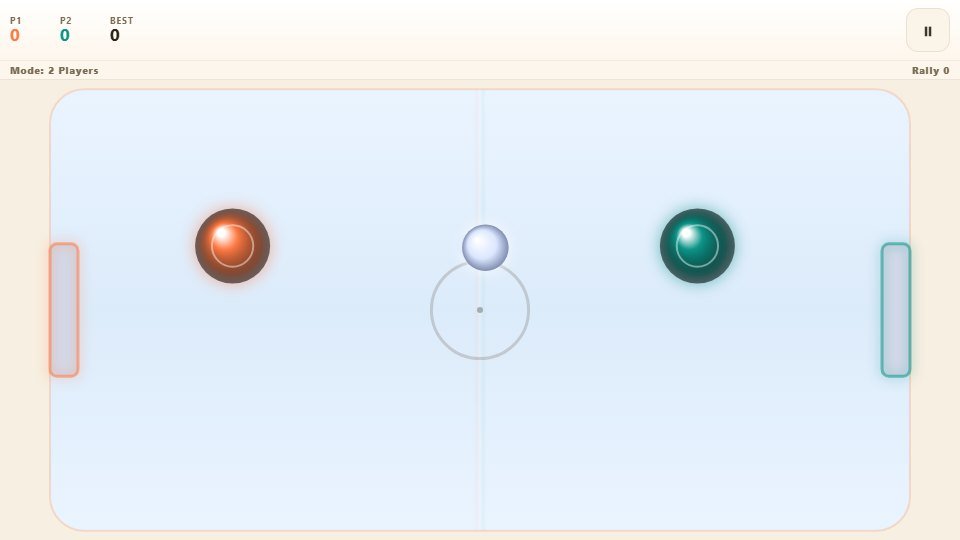
Two mallets, one rink, one phone held between you. First to seven, and the puck does not slow down for anyone.
Share one screen, take one half each and race to seven. No controllers, no internet, no mercy.
Pong is the original video game, and it remains one of the best two-player experiences you can have on a single phone. A ball bounces between two paddles, and each player controls one end. The rules take five seconds to understand and the game rewards anticipation over reaction, which makes it fair for two players of very different experience.
Pong Duel takes the oldest idea in video games and puts it on a single touchscreen. Two paddles, one ball, and two goal lines — send the ball past your opponent and their score does not go up. It is the simplest competitive format that still produces genuine rallies and genuine arguments.
The ball leaves your paddle at an angle determined by where it struck. Contact near the centre sends it almost flat and easy to return; contact near either end sends it steeply and forces your opponent to scramble. Since the ball also speeds up during a long rally, a steep return late in the exchange is usually the point-winning shot.
After every return, drift back toward the centre of your goal. Players who stay where they hit the ball get beaten by the very next shot, because the ball can travel to either corner and they are already on one side. Returning to the middle is the habit that turns a lucky rally into a controlled one.
Flicking your paddle wildly looks energetic and loses points. Watching the ball's angle as it crosses the halfway line tells you where it will arrive, and that half-second of foresight is the entire skill of the game after the first minute.
A match needs no connection, no setup, and no explanation, which makes it an easy pick whenever two people are sharing a screen. It is closely related to Air Hockey, which uses the same split-screen format at a faster pace, and to the rest of the Multiplayer collection.
Who it suits: The best two-player game here for a pair that wants something instantly understandable, and a gentle introduction to competitive play for a child.
It is designed as a shared-screen two-player game, so the natural way to play is with someone beside you. Sharing the device is what makes the rallies feel competitive.
Yes. The longer a rally runs the quicker the ball travels, which is what eventually forces a point to be won rather than letting an exchange continue indefinitely.
No fixed target is enforced. Agree a score with your opponent beforehand, or simply keep playing until one of you decides the match is over.
On a large screen each player can use a single finger on their own half comfortably. Two fingers each is unnecessary and generally makes control less precise.
Yes, that is exactly how it is built. One player controls the top of the screen and one controls the bottom, and the phone sits between you. No second device and no connection needed.
It is the best possible introduction to competitive games. One input, one rule, and losses that are always understandable — which is why it has survived for fifty years.
two player split screen retro multiplayer pass and play arcade
Two mallets, one rink, one phone held between you. First to seven, and the puck does not slow down for anyone.
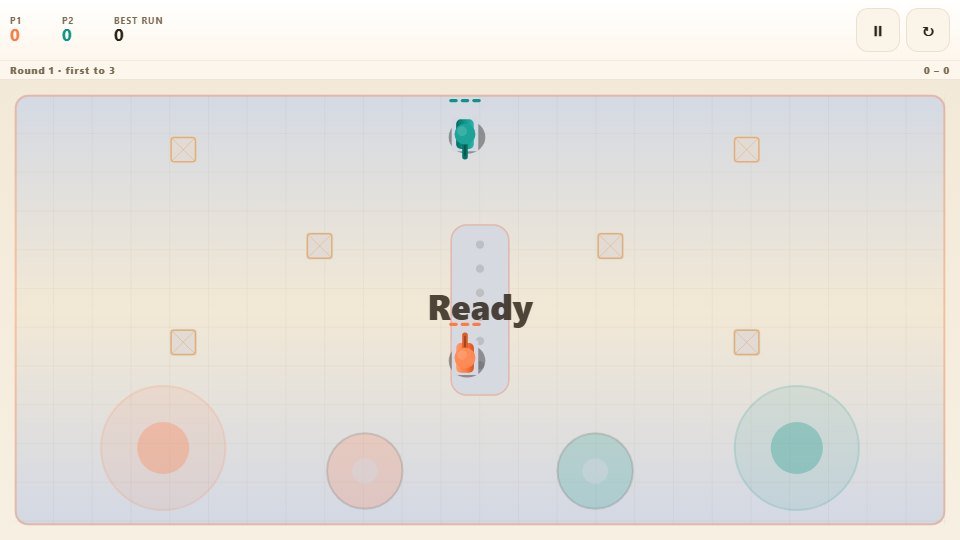
Two tanks on one screen, shells that bounce off walls, and a best-of-three that always ends in an argument.
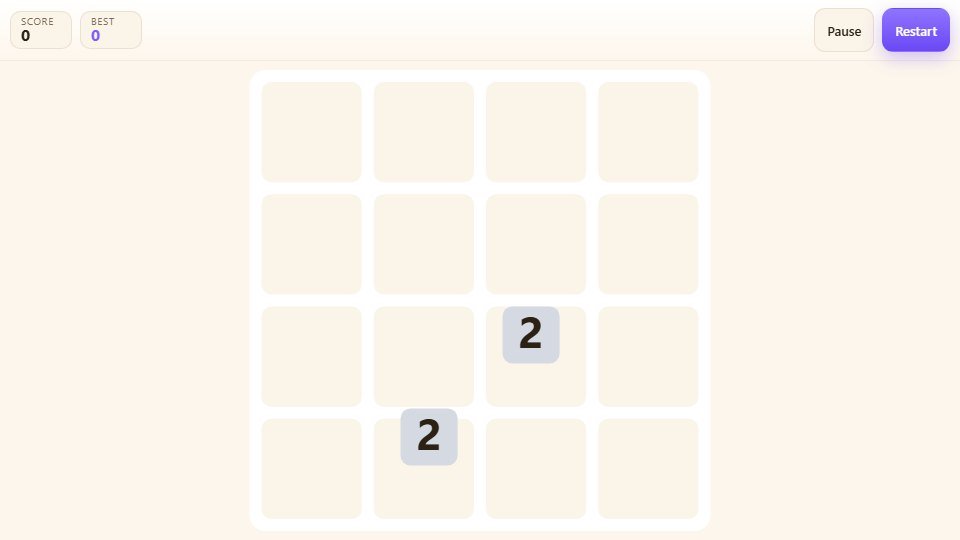
Two tiles, one thumb. Slide the board, merge the twins and build a 2048 block before the grid fills up.